Potting Soil vs Garden Soil: 3 Simple Mixes That Drain Well
Potting soil vs garden soil, compared with real numbers: cost per cubic foot, air space, drainage times, and three simple mixes that keep roots breathing.
Key takeaways
- Potting mix goes in pots, garden soil goes in the ground, and compost is an ingredient for both — not a third product that replaces either.
- A good potting mix is about 60% pore space, and roughly a quarter of that is air. Garden soil at its ideal density is about 50% pore space, and it loses the air space roots need once it is confined in a pot.
- A 5-gallon pot holds 0.67 cubic feet: about $6 of potting mix, $2.44 of bagged garden soil, or $4.67 of bagged compost at spring 2026 prices.
- Compost is safe in a container at up to half the volume; above that, the mix holds water and loses the air roots need.
- Garden soil is only useful in a container as a small fraction of a very large fill — 5 to 10% of the volume.
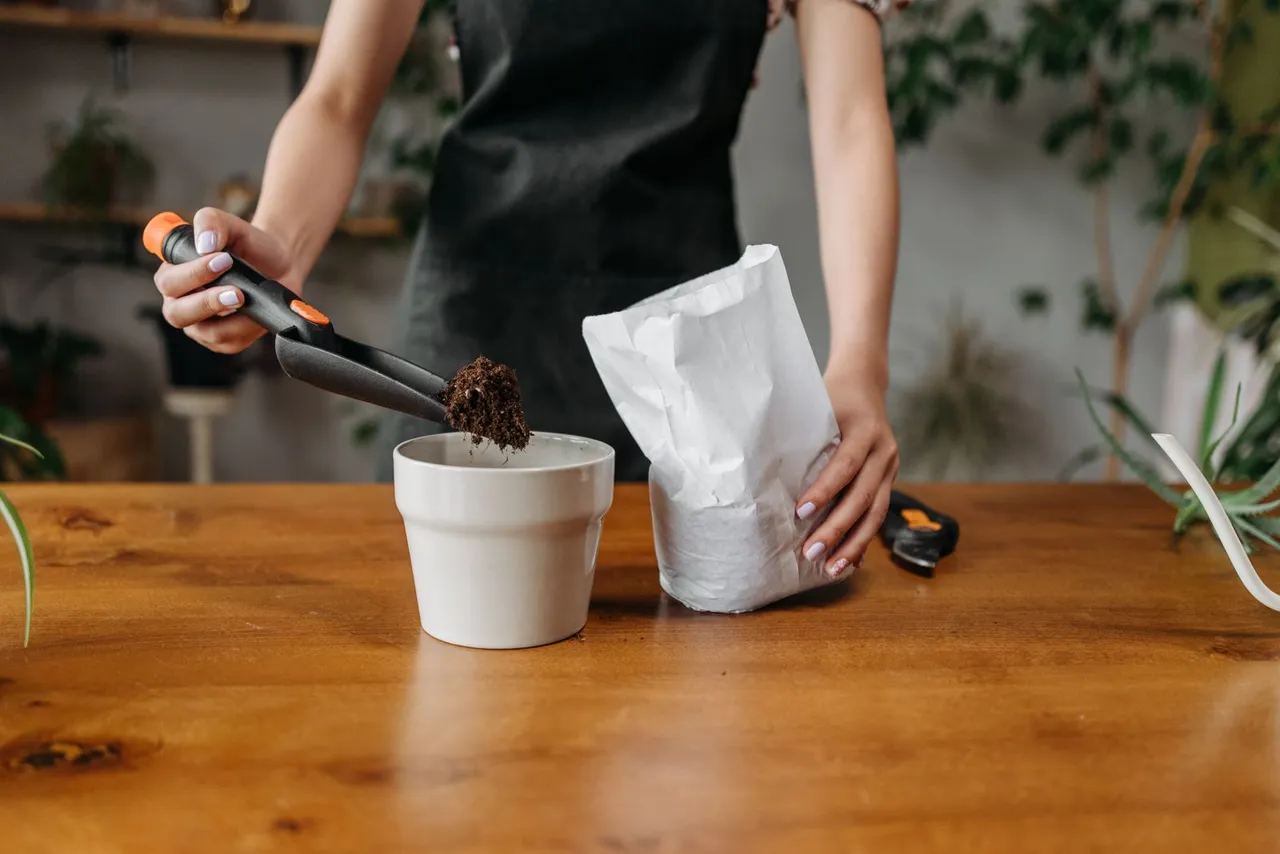
Potting soil vs garden soil is not a branding question, and neither bag answers it on the front label. One is a manufactured medium built to hold air while it sits in a closed pot. The other is mineral ground that only works while it is still part of the ground. I have worked both into the same plot: garden soil in the raised beds, potting mix in the 5-gallon pots the peppers and tomatoes start their season in. The beds held their structure through the summer. The one pot I filled with garden soil turned into a brick that water ran straight off.
Below is the short answer, then the numbers the bags leave out — cost per cubic foot, how much of the pot is actually air, and how long a quart of water takes to leave each one. It is the article I wanted when I was searching what is potting mix and getting a page of retailer blogs that all said “potting soil is for pots.”
Potting soil vs garden soil: the short answer
Garden soil belongs in the ground, in raised beds, and in the biggest containers where it is a small fraction of the fill. Potting mix belongs in pots, because a pot is a closed system with a limited volume and the plant inside it depends on that volume holding both water and air at once. Compost is neither of those things. It is an ingredient that goes into either, at up to half the volume of a container mix.
The potting mix vs potting soil question is a labelling one, and the potting soil vs garden soil question is a materials one. Both land in the same place: what goes in a pot has to keep air in it after it has been watered and confined.
That is the whole decision. Everything else — brand, price, the picture of tomatoes on the bag — is secondary to one measurable property: how much air the material still holds after it has been watered, drained and sat in a pot for six weeks.
What is potting mix, and why is it mostly air?
Potting mix is not soil, and it is not a substitute for soil. It is a blend whose job is to stay open. The potting mix vs potting soil distinction on the shelf is the first thing to get straight, because the labels are not regulated: “potting soil” is a marketing term and “potting mix” describes a soilless blend.
What is potting mix made of?
A typical bag is a moisture-holding base — sphagnum peat or coconut coir — plus composted bark for structure, plus perlite or coarse sand to keep pores open between the particles. University of Maryland Extension describes commercial soilless mixes as lightweight, well draining, free of weed seeds, insects and disease, and around pH 6.2, and notes that they are typically built from exactly those components.
Why soilless at all? Penn State Extension gives the practical reason: soilless mixes avoid soilborne diseases and promote good drainage. A pot is a small, warm, repeatedly watered environment. Anything that lives in field soil — weed seed, fungus gnat larvae, root rot organisms — gets a perfect incubator inside it.
There is a cost to that design, and it is the one thing readers write to me about. Soilless mix goes hydrophobic when it dries out completely: it repels water instead of absorbing it. Maryland Extension names the problem and the fix — work the water in with your hands, or stand the pot in a tray and let it drink from below.
The cheap-bag test follows from the same idea. Squeeze a bag in the aisle. A mix that feels light and springy, with visible white perlite and chunks of bark, is mostly pore space. A mix that feels heavy, black and clumpy is mostly fine particles and compost, and it will drain like wet cardboard.
The drainage numbers behind potting soil vs garden soil
This is where potting mix vs potting soil stops being a matter of opinion. Substrate scientists measure three things: total porosity (how much of the volume is pore space at all), air space (how much of that is air after the pot has drained), and container capacity (how much water is left).
For garden soil, SDSU Extension puts ideal soil porosity at about 50%, which corresponds to a bulk density of 1.33 g/cm³ — 83 lb per cubic foot. That is a soil in good field condition, in a field. Compacted soil at 1.6 g/cm³ is down to roughly 40% pore space, and SDSU’s texture table identifies the densities at which roots stop being able to grow at all.
For container substrates, USDA ARS researchers publish the working ranges: total porosity 50–85% by volume, air space 10–30%, container capacity 45–65%, bulk density 0.19–0.70 g/cm³. Every one of those numbers is a different world from garden soil at 1.33 g/cm³.
| Material | Total porosity (% vol) | Air space (% vol) | Density and weight |
|---|---|---|---|
| Garden soil, ideal field density | ~50 | not measured; it collapses when confined | 1.33 g/cm³ · 83 lb per cu ft |
| Pine bark : soil, 9 : 1 | 74 | 15 | 0.31 g/cm³ · 19 lb per cu ft |
| Pine bark + perlite + peat moss, 70:15:15 | 85 | 14 | 0.18 g/cm³ · 11 lb per cu ft |
| Peat + bark + perlite + vermiculite potting mix | 59 | 17 (28% of the pore space) | not reported in the source |
| Suggested range, container substrates | 50–85 | 10–30 | 0.19–0.70 g/cm³ · 12–44 lb per cu ft |
Two rows need explaining. The potting-mix row is Purdue Extension’s measured peat-bark-perlite-vermiculite blend: 59.1% porosity with water occupying 72% of the pore space and air 28%, which works out to about 17% of the pot’s volume as air — inside the 10–30% working range, and just under the 20–25% air space Purdue names as ideal for root growth. And the pine bark : soil row is what happens when you do add mineral soil to a mix — it still keeps 15% air space, because 90% of it is bark, not soil.
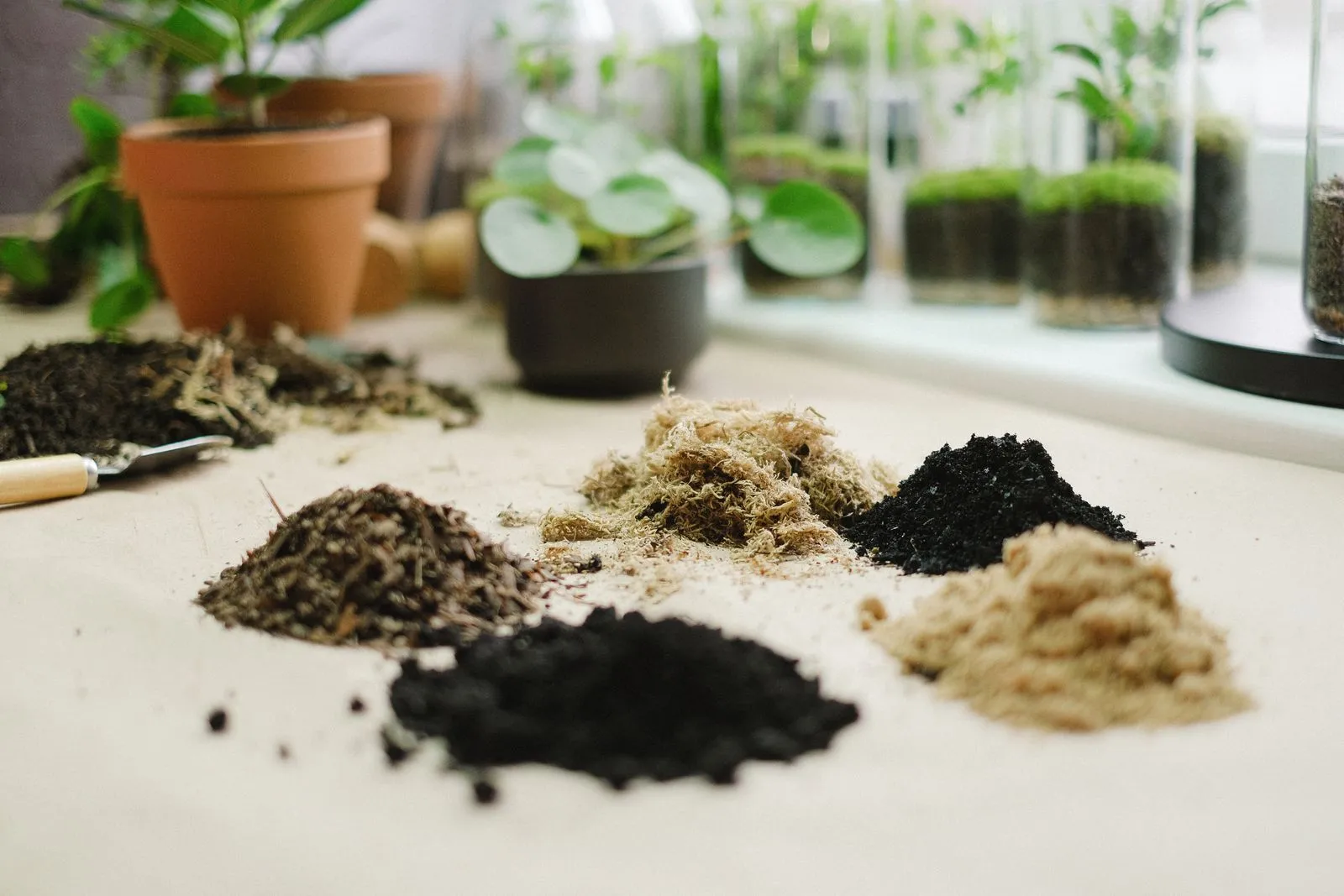
Photo: Anna Shvets via Pexels (https://www.pexels.com/photo/soils-for-plants-on-table-5830992/)
Then there is the part nobody puts on a bag: the perched water table. Purdue’s guide explains that in spite of drainage holes, a zone at the bottom of every container never drains, because gravity’s pull on the water in it is weaker than the capillary hold of the mix. That zone has virtually no air in it. The shorter the container, the bigger a share of the total volume that drowned zone becomes. Height is why a tall pot dries faster than a shallow one.
Put a pot’s worth of garden soil into that picture. Its 50% porosity is made of very small pores, spaced closely enough that water hardly moves through them; the air space holds until the first few waterings, then the structure slumps, the mix settles, and what is left at the bottom of the pot is a saturated layer with nowhere to drain. That is the mechanism behind the “rotted at the crown” story, and it is why watering tactics cannot rescue a medium that has no air in it.
What potting soil vs garden soil costs per cubic foot
Price is where potting soil vs garden soil looks like a one-way contest. Garden soil is undeniably cheaper per cubic foot, and potting mix looks like a rip-off by comparison. It is worth doing the arithmetic, because the units on the bags are not the same. These are prices I paid in spring 2026 at a garden center and a landscape supply yard, converted to a common unit; they move with region and season, so treat the ratio as the durable part.
| What I bought | Pack size | Cost per cubic foot | Cost to fill a 5-gallon pot (0.67 cu ft) |
|---|---|---|---|
| Potting mix, bagged | 2 cu ft | $8.99 | $6.01 |
| Garden soil, bagged | 1.5 cu ft | $3.65 | $2.44 |
| Compost, bagged | 1 cu ft | $6.98 | $4.67 |
| Garden soil or compost, bulk | by the cubic yard | about $1.40–$1.56 | about $0.94–$1.04 |
Three things fall out of that table. Bulk is dramatically cheaper per cubic foot, but only if you can take a cubic yard at a time and have somewhere to put it — a cubic yard fills roughly 40 five-gallon pots. Bagged compost costs nearly as much as potting mix, so it is a poor choice as the bulk of a fill. And bagged garden soil is the cheapest bag on the shelf, which is exactly why it ends up in pots.
The arithmetic that matters is not cost per cubic foot, though. It is cost per pot that is still alive in August. A 5-gallon pot of garden soil saves you $3.57 against potting mix and gives you a plant that drowns slowly. A 5-gallon pot of potting mix at $6.01, plus $1.55 of compost for the third of the fill that is compost, and a season of fertilizer, grows a tomato or a pepper to the end of it. That is the trade, and the cheap option is the expensive one.
Weight is the other cost, and it is measured in your back rather than your wallet. At 83 lb per cubic foot, garden soil in a 5-gallon pot weighs about 55 lb before you have watered it and close to 75 lb at container capacity — 45% of the volume as water, the low end of the published range. That is a two-handed lift when the pot is empty of anything but soil. The same pot of potting mix comes in around 12 lb.
The test that settled it for me
I stopped arguing about potting mix vs potting soil and ran the comparison in the 2026 season, in three identical 2-gallon nursery pots on the bench beside my beds. Same plant, same watering can, same day. A quart of water into each, timed with a phone.
The potting-mix pot passed the quart through in about 20 seconds and was still light when I lifted it. The compost pot took just over a minute, and the saucer filled. The garden-soil pot took four minutes to pass the first pint, then stopped — the remaining water sat on the surface and ran down the inside wall of the pot instead of through it. Twenty minutes later it was still standing in water.
That is potting mix vs potting soil in one quart, and it matches what the numbers say: the material with the most air space moves water fastest, and the material with the most small pores holds it in the pot. If you only ever do one test on a new bag, do that one, in a spare pot, before you commit a plant to it.
Where garden soil belongs
Garden soil is not bad — it is the right material in the wrong container. That is the part of potting soil vs garden soil that most articles get backwards: the material is fine, the container is what ruins it. In a bed or a raised bed the ground drains sideways and downwards without limit, roots can grow out of trouble, and the soil structure is maintained by worms, roots and weather. Use it there.
In containers, Iowa State University Extension gives both halves of the answer: garden soil alone is not a good growing medium in a container, because it compacts, drains poorly and pulls away from the pot wall as it dries; and if you want to make your own mix, use equal volumes of garden soil, sphagnum peat and perlite. That is one-third soil inside a mix designed to stay open, not a pot of soil.
Maryland Extension is blunter still. Topsoil should only go into very large containers, and should not exceed 5 to 10% of the volume. Even the measured bark : soil mix in the ARS table is 90% bark.
The one tradition that does put soil in a pot is the British loam-based mix. The RHS’s recipe starts with garden soil as a base, adds garden compost or leafmould, and adds sharp sand or grit for drainage — with a warning not to use soil carrying oxalis, horsetail or ground elder, because those spread into the container.
Read that as the exception that proves the air-space rule rather than a defence of garden soil: the soil is one component of a blend, worked through a sieve and mixed with coarse material, and the mix that comes out is heavy. It also settles part of the potting mix vs potting soil argument on price rather than principle, because the RHS notes that bagged potting compost is expensive, which is why the homemade route is worth taking.
If you are filling a 15-gallon planter for a shrub, you can stretch to a shovel of garden soil through the fill, mixed thoroughly, and it will do no harm. What you cannot do is fill a 5-gallon pot with it and hope. Read potting soil vs garden soil as a question about volume and drainage, not about which material is better — in the ground, garden soil wins by a mile.
Where compost belongs in the mix
Compost is the most over-trusted bag on the shelf. The potting mix vs potting soil debate has a third character, and this is it: compost is genuinely good, with plenty of nutrients and a living microbial population, and it improves both water holding and drainage when it is blended in. My own compost bin supplies most of what goes into my mixes.
It is also a poor pot medium on its own, for a structural reason. ARS’s authors explain that composted material holds water inside its particles like a sponge, and lacks the coarse particles that provide aeration, so compost is not used above 50% of the volume in most container substrates. That is the rule I work to: one part compost to two or three parts potting mix, never a pot of pure compost.
Maryland Extension adds a complication worth stating honestly. Vegetables, herbs and flowers can be grown in 100% compost or leaf mold, and community gardeners in Baltimore have done it for decades — but the same guidance warns that compost loses nutrients and breaks down physically over time, and gardeners there run it as a fed, monitored system. In a 5-gallon pot I want to water twice a week and then forget about, a compost-heavy mix shrinks by a couple of inches a season, densifies, and stops draining.
If you make your own, the compost browns and greens ratio matters more than the bin you choose, because compost that was mostly greens turns into a wet mat that does in a pot exactly what garden soil does. Get the ratio close to right and the finished product is crumbly, open and sweet-smelling, which is what a mix ingredient needs to be. Finished compost should smell sweet and earthy, not sour.
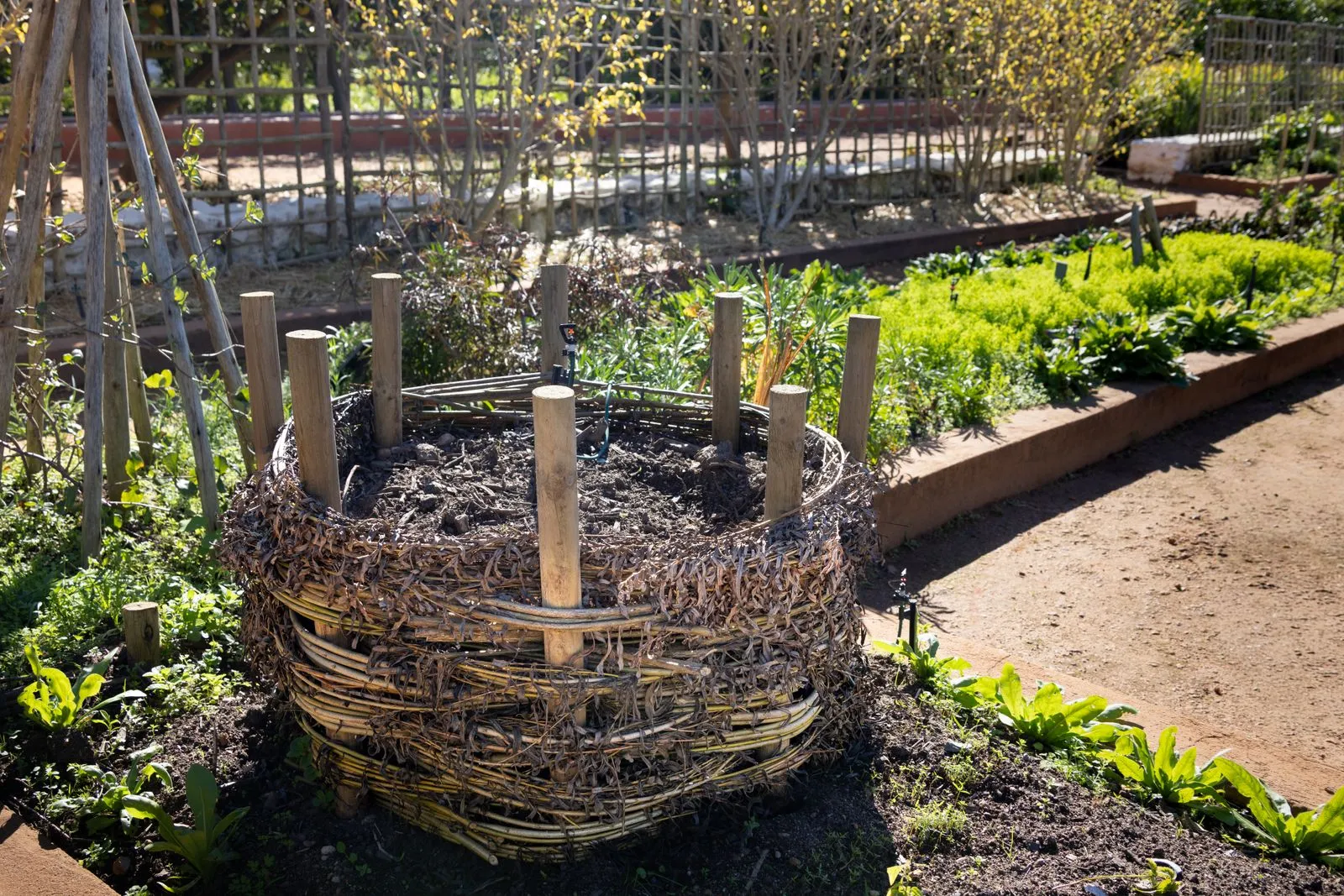
Photo: Magda Ehlers via Pexels (https://www.pexels.com/photo/sustainable-garden-composting-in-spring-light-38319851/)
3 simple mixes that drain well
All three are by volume, scooped with the same pot, and all three are built around keeping air space in the fill rather than around what looks rich. None of them is a potting mix vs potting soil argument — every one of them starts with potting mix and uses garden soil only as a minor ingredient or not at all.
General mix — most vegetables, herbs and annuals. Two parts potting mix, one part compost, one handful of perlite per 5-gallon batch. This lands near the middle of the recommended air-space range and holds enough water for a plant in full sun.
Sharper mix — succulents, rosemary, lavender, anything from dry ground. Three parts potting mix, one part perlite plus coarse grit. The aim is to push air space above 25% so rain cannot pool around the crown.
Big-planter mix — shrubs and small trees. Three parts potting mix, one part compost, and one part garden soil only if the container is 15 gallons or larger. Keep the garden soil under a tenth of the total fill and mix it through the whole volume rather than layering it.
Two rules hold across all three. Mix them thoroughly, in a wheelbarrow or on a tarp, because a layered pot creates a boundary where water stalls. And never fill a pot with gravel at the bottom to improve drainage: a layer of gravel under the same fine mix does not create a drain, it just moves the perched water table up into the mix where the roots are.
If you are raising plants from seed, the mix changes again: seed-starting mix is finer and nearly nutrient-free, and starting seeds indoors covers the rest of that method.
What the cheap bag really costs
The reason garden soil keeps ending up in pots is that it is the cheapest bag with soil in the name, and the reason cheap potting mix does too is that they look alike. Maryland Extension’s description is useful here: poor-quality mixes are often inexpensive, black, heavy and slow to drain, while a good one is lightweight, drains well and does not compact.
So what is potting mix, if the bag will not say?
The test is in your hand, in the aisle. Pick up two same-size bags and compare weight. Lift the corner and feel for bark chunks and perlite. Look at the ingredient list: if the first ingredient is topsoil or “composted forest products” with no perlite anywhere, it is a garden-soil substitute in disguise — and it fails the potting soil vs garden soil test in the worst way, holding water in a pot that cannot drain it.
Reusing last year’s mix
You do not have to replace potting mix every year, but you cannot reuse it unchanged. Over a season the organic fraction breaks down and the structure compacts, so air space falls — the potting soil vs garden soil problem creeping in from the other direction, as a good mix slowly turns into a poor one. Maryland Extension’s recommendation is to empty the containers, remove plant residues, store the medium, and mix last year’s material 50:50 with fresh mix or compost next season — and not to save the medium from pots where root disease was a problem.
My rule matches theirs, with one addition: refresh the top two inches as well, because that is where the roots of a transplant do most of their work.
The short version, priced
Potting soil vs garden soil comes down to one question: does the material hold air after it has been watered and confined? Garden soil, at its best, is 50% pore space of a kind that collapses in a pot. Good potting mix is around 60% pore space, a quarter of it air, and it costs about $3.57 more per 5-gallon pot. That is the entire premium, and no potting mix vs potting soil label on any bag changes it.
Buy potting mix for pots and compost for the blend, keep garden soil for beds and the biggest planters, and put the money you save on a bulk load into one bag of proper mix. That is the whole of potting soil vs garden soil in a pot, and it is a decision you can settle in ten minutes with a spare pot and a quart of water. The rest of the soil and compost guides are under Soil and Compost, and if you are already growing in containers, kale in a pot is the cheapest way to test whether your mix is working.
QUESTIONS GARDENERS ASK
Common questions
What is the difference between potting soil and garden soil?
Potting soil (properly, potting mix) is a manufactured blend of peat or coir, bark and perlite built to stay open in a pot. Garden soil is mineral ground soil. In a container, garden soil compacts, loses its air spaces and stops draining, which is why extension services recommend a soilless mix instead.
Can I use garden soil in a pot?
Only as a small fraction of the fill: 5 to 10% of the volume, and only in a very large container. On its own it compacts into a dense mass, holds water in its small pores, and pulls away from the pot wall as it dries, which makes watering a plant in it almost impossible.
Is potting soil the same as potting mix?
No, and the labels are not regulated. A bag sold as potting mix is soilless — peat or coir, bark, perlite — and built for containers. A bag sold as potting soil may be mostly mineral topsoil with a little compost, so read the ingredient list rather than the front of the bag.
Should I put compost in my potting mix?
Yes, up to about half the volume. Compost adds nutrients and biological life, but composted material holds water inside its particles and lacks the coarse particles that keep a pot aerated, so extension guidance caps it at 50% of a container mix.
What is the cheapest way to fill a large raised bed or planter?
Buy the mineral and organic bulk components separately: bulk topsoil or garden soil for the body of the bed, compost for the top third, and a small amount of potting mix around each planting hole. Bagged potting mix is the most expensive way to fill a volume bigger than a few cubic feet.
How do I fix potting mix that has gone hard and dusty?
Soilless mix turns hydrophobic when it dries out completely, so water runs down the inside wall of the pot instead of soaking in. Stand the pot in a tub of water for half an hour so it rehydrates from below, then break up the surface. If the mix has compacted and shrunk away from the sides, refresh it instead of reviving it.
Can I reuse potting mix from last year?
Yes for a pot that held a healthy plant. Empty it, pull out the old roots, mix it 50:50 with fresh mix or compost, and it will do another season. Do not reuse the mix from a pot where a plant died of rot, and do not reuse it for the same plant family.
Sources
- University of Maryland Extension — Growing Media (Potting Soil) for Containers
- Purdue Extension HO-287-W — Understanding the Pores of a Soilless Substrate
- USDA ARS — Bilderback et al., Healthy Substrates Need Physicals Too! (HortTechnology 15:4)
- Iowa State University Extension — Can I use garden soil in containers?
- SDSU Extension — Bulk Density is an Indicator of Soil Health
- Penn State Extension — Potting Media and Plant Propagation
- RHS — How to make your own potting mix
 Soil & Compost
DIY Compost Bin: 5 Simple Builds, Ranked by Skill and Cost
Build a diy compost bin that holds heat: five extension-service plans compared by skills, materials and size, plus the siting and fixings that matter. Soil & Compost
How to Start a Compost Bin: 5 Simple Steps
How to start a compost bin in five steps: the browns-to-greens ratio, the bin size that heats, the moisture test, and four faults that stall a pile. Outdoor Spaces
Growing Tomatoes in Containers: 5 Simple Rules for Pots
Growing tomatoes in containers works when the pot is measured in gallons: minimum pot volume, watering a small root zone, and varieties that fit a pot.Reading us often? Add MyGreenyGarden as a preferred source on Google and our guides are more likely to be highlighted when you search.